Specializing in Martele silver by Gorham as well as other fine American and Continental sterling | home

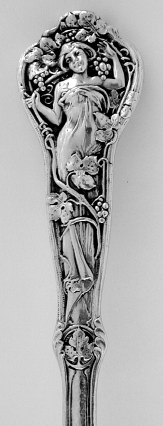
Punch Ladle (1903)
Exhibited at the
St. Louis Exposition
St. Louis, Mo. 1904
Martele Book Updates
In order to further advance the study of Martele and to maintain the accuracy of the information published in the book Martele: Gorham's Nouveau Art Silver, check back periodically for new research, factual additions, or corrections.
June 8, 2026
Clarification. The November 28, 2025 discusses the likelihood of an item being missed in the goal of identification of all Martele items. What was not included in the information was about the possibility of a piece having added marks. The author has seen several pieces that were not Martele, but did have Martele marks on a piece of hammered / raised silver. There were other makers in the period such as Black, Starr and Frost as well as Codman and Codman that did similiar pieces. With the recent (current) value of Martele compared to similar silverwork, there is an incentive to create a deceptive piece. There are ways to verify if an "unlisted" piece is a Gorham produced piece of Martele versus another maker. A careful examination will help to make a determination.
January 26, 2026
New information. In the records the AAT-v tankard that is silver with an ivory body is recorded with a weight of 29.65 ounces. The tankard has been examined and the total weight is 42.60 ozt, indicating that the company weights for the pieces of Martele that include materials other than silver may reflect just the silver.
December 7, 2025
Clarification. The Paris Exhibition of 1900 is typically viewed as the first major showing of Martele, though in fact more Martele was at the Waldorf release in 1897. While a fair numbert of Martele items were part of the Gorham's Paris display, they were not the only items. The company offered a variety of goods that included non-Martele silver dinner services and other silver items, Rookwood and silver pieces, 18K black coffee and tete-a-tete sets, 18k dresser and child sets, 18k match safes, leather goods, etc. The display was truly a showcase of the range and quality of the company's wares.
December 6, 2025
New information. On page 204 the notes for chamberstick 3169 indicate the piece "may have been exhibited in Paris, but mark erased on photo though shows Paris in costing." The note needs to remain for clarification of the discrepancy for future researchers, especially since the piece was in a run of items bound for Paris. Woodward's album of Martele and non-Martele items sent to Paris was reviewed, and 3169 is not included. Photos of the chamberstick have also been examined, and the Paris mark is not present.
November 28, 2025
Clarification. Through the years the author has had inquiries about pieces of Martele "not listed" in the production tables. Some duplicate items have been recorded where the specific records did not specify more than one piece being made (such as a request for a matching item) and listed on the book update page, but the original item, the code and the piece type have all been listed in the book. Since the book's publication in 2002, to date only a single piece of Martele is known by the author to not have been included in the tables, an 1897 pitcher (see update January 15, 2004). The author was aware of pitcher before publication, but at the time of writing appropriate documentation was not available to definitively establish the item as Martele though the verification was later found (all items listed had multiple measures of verification to prevent misidentification based on a single entry - in fact, code errors made by the factory are also listed and corrected in the book to prevent future researchers from "finding" a missing item). There is also the known Martele bowl R/YS that was duplicated and only having Birks marks (a company with a relationship with Gorham), but so far the bowl is the only piece that has been identified as unmarked Martele (see the "Unmarked Martele" article posted on the site).
Over the years a small number of pieces have also been seen that are the similiarily made items, hammered work, such as silver by Gorham, the company of Black, Starr and Frost, Codman and Codman, and others, with spurious Martele marks added that are not Martele. As noted in the book, the research to document pieces included recording information from code and specific job assignment ledgers, costing sheets, cards indicating metal weight, photograph date cards, uncoded parts boxes (for pieces such as flatware), making room personnel cards, etc. Gorham was a very large and industrialized company, documenting every step of the making process for each piece for quality and pricing / cost control (such as beginning and ending precious metal weights). In the preface to the book the author indicates that "the majority of the data was gathered from loose photographs and photo albums (probably in the neighborhood of 50,000 images) and costing slips (probably in excess of 100,000) as well as countless ledgers, journals, folders, files, file cabinets, wooden drawers, envelopes and so on were examined" trying to find all possible Martele information during the searches within the company silver records at the Gorham factory and Brown University. With the precise record keeping at every step of the making process and the comprehensiveness of the research, the likelyhood of a "regular" or "exceptional" piece of Martele not being somewhere in the records, except for "possibly" an additional uncoded item (such as the flatware identified and in the book) in the "parts" boxes, is basically zero. Any corrections to this clarification will be added, if needed, on the book updates page.
March 16, 2025
New information. On page 158, for the listing of items with the Codman signature, add the H/VP loving cup completed 1905. The H/VP cup was verified through photographs. The signature is script "W. Codman des.".
March 6, 2025
General Information. An advertisment for an exhibition of silver was found that the author had not seen. The Waldorf exhibition of 1897 is considered to be the initial showing of Martele. The newly viewed advertisement for an April 9, 1900 exhibit (not a standard sales ad) of the "latest production of sterling silverware" has the image of the (1510) Martele ewer. It is not clear if the exhibition was for Martele or other silver, with Martele maybe included at the Shreve, Crump and Low of Boston showing. The (1510) ewer would be in the Paris Exhibition which opened April 14, 1900, making it rather unlikely that the ewer could be at the Boston showing, In fact, the image for the notice appears to be the same one used by the Gorham Company advertisement in the Country Life November, 1901 advertisment illustrated in the book on page 47. The implication is that the ewer drawing may have become a "stock" image.
April 18, 2024
General Information. A question was asked about the registration "R" with the Martele eagle on the home page. The author of the book is registered in the United States Patent and Trademark Office (USPTO) as having current and continuing ownership of the Martele eagle mark.
April 18, 2024
New Information. On page 204 the notes for chamberstick 3164 indicate the piece "may have been exhibited in Paris, but mark erased on photo though shows Paris in costing." The note needs to remain for clarification of the discrepancy for future researchers, especially since the piece was in a run of items bound for Paris. Woodward's album of items sent to Paris was reviewed, and 3164 is not in the photos. The chamberstick has also been examined, and the Paris mark is not present.
March 20, 2023
New Information. A number of newspaper advertisments and several news items dating from 1900 to 1914 (the vast majority 1900-1902) were reviewed. Advertisements were found in the Atlanta Constitution, Boston Daily Globe, Brooklyn Daily Eagle, New York Sun, New York Times, New York Tribune, Philapelphia Inquirer, Savannah Morning News, Topeka State Journal, Washington Evening Star, Wilmington Evening Journal, and World.
Of particular interest is an article from the New York Tribune (April 16, 1900) indicating that the "People who saw the exhibit before it was shipped to France expressed their opinion that the martele work by the Gorham Company marked the revival of the art of the guildsmen of old, with the greater mechanical efficiency of the modern artisan. The owners of the new examples do not know, of course, just what kind of reception awaits their exhibt on the other side, but they believe that it will be a revelation of the skill and artistic capabilities of America." That "unknown" is followed up by advertisments in papers beginning October of 1900 about Gorham and their "Grand Prix Silver."
Another interesting advertisement was found in a New York Times (March 23, 1914) column for Gorham's wedding gifts where the mention of "the exquisite individual Martele pieces" is found. The continued promotion of Martele in the ad is the latest that has been seen by the author.
November 20, 2022
New Information. Four examples of the H/RJ candlestick have been documented. On page 334 under the notes add "four made." On pages 140 and 144 change the number of candlesticks made to 151, and on page 143 change the total to 7659.
September 27, 2022
Misc. The name of the book has been corrected. The private publisher of the book incorrectly submitted the title to ISBN as "Martele: 950-1000 Fine, Gorham's Nouveau Art Silver" based on the design on the cover page and dust jacket. ISBN (for number 9780929526522 or
0-929526-52-X) has changed the title in the registration database at the request of the author to the correct Martelé - Gorham's Nouveau Art Silver.
September 26, 2022
New information. A new reference has been found. The article is a New York Times (September 18, 1900) review of the Paris Exhibition of 1900. The review includes a mention of Gorham and Martele. The link will open a PDF file.
New information. On page 158, for the listing of items with the Codman signature, add the BWG, BWH, BWI, BWJ black coffee set. The items were verified through photos of the set. The set continues the author's suggestion that the run with signatures during 1913 likely corresponds to Codman's retirement.
In an article published in Silver Magazine, The "Codman Vase" - A Gift of Martele (July-August, 2011), the author theorized that the 1913 run of Codman signed Martele was related to his pending retirement during 1914. Known signed pieces all fell in the BVQ to BWN range, and were completed between August and October. There are also two pieces preceding BVQ, the codes of BSW and BSX, that fell within the timeline of the run. The author speculated that perhaps there was a signed piece for each of the 22 years (with a couple of unsigned pieces already known also in the run). The item codes and known signed / unsigned are:
BSW
|
pitcher
|
08-28
|
1913
|
|
unknown
|
BSX
|
pitcher
|
08-28
|
1913
|
|
unsigned
|
BVQ
|
pitcher
|
09-04
|
1913
|
|
signed
|
BVR
|
pitcher
|
08-28
|
1913
|
|
signed
|
BVS
|
pitcher
|
08-28
|
1913
|
|
unknown
|
BVT
|
tray - pitcher
|
08-28
|
1913
|
|
unsigned
|
BVU
|
vase
|
08-28
|
1913
|
|
signed
|
BVV
|
tray
|
08-28
|
1913
|
|
unknown
|
BVW
|
vase
|
09-25
|
1913
|
|
unknown
|
BVX
|
vase
|
10-26
|
1913
|
|
unsigned - last of series by date, the Codman vase (see articles)
|
BVY
|
vase
|
09-17
|
1913
|
|
unknown
|
BVZ
|
love cup - 3 handle
|
10-08
|
1913
|
|
signed
|
BWA
|
love cup - 3 handle
|
10-08
|
1913
|
|
unknown
|
BWB
|
love cup - 2 handle
|
09-25
|
1913
|
|
unknown
|
BWC
|
dish - salad
|
08-28
|
1913
|
|
unknown
|
BWD
|
bowl
|
09-11
|
1913
|
|
signed
|
BWD
|
bowl
|
10-17
|
1913
|
|
unknown - there may be two BWD bowls
|
BWE
|
bowl
|
08-28
|
1913
|
|
signed
|
BWF
|
bowl
|
09-17
|
1913
|
|
signed
|
BWG
|
coffee pot - black
|
09-30
|
1913
|
|
signed
|
BWH
|
cream
|
09-30
|
1913
|
|
signed
|
BWI
|
cream
|
09-30
|
1913
|
|
signed
|
BWJ
|
tray
|
09-30
|
1913
|
|
signed
|
BWK
|
coffee pot - black
|
09-30
|
1913
|
|
signed
|
BWL
|
sugar bowl
|
09-30
|
1913
|
|
signed
|
BWM
|
cream
|
09-30
|
1913
|
|
signed
|
BWN
|
basket
|
10-06
|
1913
|
|
signed
|
(File - list of Codman signed pieces)
March 16, 2022
New information. In Carpenter's book on Gorham Silver, he suggests that the initial showing of Martele may have been at the Boston Arts and Crafts Society exhibition during April of 1897. The author of Martele: Gorham's Nouveau Art Silver reviewed information and documentation from the exhibit and did not find support for Martele being display with the Gorham exhibit. The author did, however, suggest another possibility of a display of Martele before the Waldorf-Astoria. Gorham participated in the Rhode Island Industrial Exhibition held during June of 1897. Photographs of the Gorham display cases at the expo were viewed. The images were from newspaper print however, with some items slightly difficult to see clearly. However, from the form of the items there does not appear to be Martele within the display cases. In addition, with the type of fanfare later received when the silver was displayed at the Waldorf, the comparative lackluster review of the exhibit in the Vol. 4, 1897 Providence Journal of Commerce stated "The exhibit of the Gorham Manufacturing Company and of Tilden-Thurber Co., was centrally located on the third floor in the jewelry department, between the entrances into the two wings. Here were displayed the artistic production of the great silverware manufacturing plant in all their variety and beauty, and their arrangement gave evidence of the taste and skill in showing goods for which the Tilden-Thurber Co, are justly famous. Between the showcases on the counter was a bronze bust of the 'Grand old Man,' Hon. Wm. E. Gladstone." Undoubtedly, with that review, if Martele would have been there the pieces would have been noticed and reported. In addition, being early in the making of Martele, items that would have been completed in time were mostly large (loving cups, coffee items, pitchers), fitting for an exhibition, and would be easy to see in the displays. Overall, in the review of the Providence exhibition, Martele does not appear to have been displayed, which leaves the Waldorf-Astoria as the initial showing and sales for the new Martele line.
June 18, 2021
New information. In the book the author indicates that the Special Order centerpiece bowl IVM appears to be the last identifiable, original piece of Martele produced (page 21). All later Martele, except for the (1931?) H/GH and H/GI Samples, were Special Orders. Within the late Special Orders, some unnumbered / unidentified pieces of child's flatware were produced, which are likely the last pieces. There were also 12 service plates made to match the earlier, and same KXJ code (April 27, 1906) plates, that were completed August 18, 1937. A re-examination of Gorham's Specials Assignment Ledger clarifies the status of IVM. The ledger follows an alphabetical order code, for example AAA to AAZ, ABA to ABZ, etc. The years covered by the ledger are May 15, 1918 (Special Order PSA) to April 18, 1949 (Special Order JGZ). The IVM code assignment was January 26, 1936. The design is dated January 22, 1937 (for clarification, the book lists 12237 which could be either 1-22-37 or 12-2-37 in Gorham's format which can now be clarified), with a photograph entry date of March 15, 1937, a completion date of March 18, 1937, and a photograph dated May 1, 1937. The are no Martele code assignments in the ledge after IVM. IVM does appear to be the final, new piece of Martele. IVM is accounted for in a private collection.
November 1, 2020
New information. The 1907 example of the (4719) gravy boat has been confirmed. The piece is marked with the later .9584 standard but still has the early Sample mark in an oval. The .9584 use was noted to begin during 1905. The gravy boat currently weighs 12.15 troy ounces. In the book on page 220, change the standard from .950 to .9584.
February 14, 2019
New information. A second covered vegetable dish numbered 4717 has been documented. The second dish has a Gorham date mark for 1905. On page 221 of the book add "2 made" in the notes section. On page 141, change "dish - vegetable - covered with handles" from 12 (from prior changes) to 13. On page 143 change the "total" from 7655 to 7656. Make the change on pages 145. On page 220 add to the "notes" line that a second dish was completed in 1905.
March 5, 2017
New information. Gorham made several electroform pieces of Martele around 2001. They were copies of existing Martele, such as the (3979) berry bowl that was exhibited in Paris in 1900. We believe there were 4-6 pieces made, with the (3979) bowl verified. Because of the process, the pieces will be exact duplicates of other Martele items, not a "new" form. The items hold a rather unusual place in the Martele line. They were made by Gorham and copies of other items such the same as some of the original items cast in Martele, so in the are in a sense Martele just created by a different process (while most Martele was hand raised, some items were cast or spun). The (3979) bowl is marked with the three Gorham hallmarks (not the Martele eagle or word) and .999 (pure silver due to electroforming).
March 31, 2016
New information. The 51.20 ounce BWD bowl on page 280 does not have a silver standard , change that to 9584. In the notes indicate that the bowl has a Codman signature and is dated 1913.
June 13, 2015
New information. A second Sample vase condiment tray 4740 has been documented. On page 221 of the book add "2 made" in the notes section. On page 141, change "dish - almond, bonbon, olive, mayonnaise, and other" from 275 (from prior changes) to 276. On page 143 change the "total" from 7654 to 7655. Make same change on page 144.
November 22, 2014
New information. On page 426, for the S/XS candlesticks, under notes add "4 made." The four have been verified. On page 140 change the number of candlesticks to 148. On page 143 change the total number of pieces to 7654.
October 16, 2013
For Gorham's major Samples and Specials photo album, the primary album for pictures of Martele, note is made that below each (?) of the pictures is the item's factory price written using the Gorham code system. The code system is found on page 160 of the book.
December 30, 2012
From the March 18th correction, on pages 141 and 144 change the coffeepot-black number to 166, and the total number on page 143 to 7652.
December 30, 2012
New information. On page 188 the book lists a single (1598) compote for the Paris Exposition (records did not indicate more than one made). Two pairs (one with monograms and one without) of the (1598) compote have been documented. Both pairs show similiar decoration and full marks for Paris. On page 188 in the notes, add "4 made," on page 55 indicate 4 compotes, on pages 141 and 144 change the number of compotes to 136, on page 143 the total should be 7653, and on page 36 change Job Washington's totals (two places) to 80 (only a single chaser was noted in the records).
March 18, 2012
In the book the notation for the (1597) black coffee pot indicated that the piece was listed as Martele in the ledger, but not on the factory costing slip. No Gorham photo of the set was available to confirm the status. A contemporary photograph of the set has been seen and the set is not Martele. Delete or modify the entry to reflect the finding.
February 24, 2012
New information. A second Sample vase coded 8793 has been documented. On page 243 of the book, delete the question mark after "2 made." On page 143, change "vase" from 362 (from prior changes) to 363. On page 143 change the "total" from 7650 to 7651.
August 28, 2011
New information. An advertisement regarding the Waldorf - Astoria exhibition of Martele was placed in Life the week of November 18, 1897, and states that there will be "a collection of wrought sterling silverware, representing examples of the handwork of the most skilled artisans of the present day." The advertisement notes the "exhibition will appeal to collectors of rare silverware and connoisseurs of art metal work."
New information. An article published on September 18, 1900 in the New York Times and titled "Americans As Art Workmen" discusses Gorham and Tiffany in the Paris Exhibition. A number of interesting comments are made in the article including "... in nothing, however, is the display more elaborate or more interesting than that in hand-wrought silver, to which they have given the name of Martele..." and "...(the) silver is original ... and it attracts the highest admiration from the connoisseurs in art from all countries..." A final line discussing the Martele states "The work in this Martele collection was commenced four years ago, and was completed only about the time of the opening of the exposition." On page 18 of the Martele book the author addresses the common notion of the silver work being held until the release at Paris and provides information indicating the inaccuracy of the idea.
March 14, 2011
New information. On page 158, for the listing of items with the Codman signature, add the 4606 Sample teapot. The author examined the six piece 4606 coffee set. The teapot was the only part of the set bearing the signature.
August 12, 2009
New information. On page 264, for the (9954) compote. The author indicates that a second compote (or pair) with the sample number may have been made during 1914. A later compote (single) has been verified by later Martele marks, the 1914 Gorham date mark, and a 1914 inscription. Correct the information to read the silver standard as .9584, and the information line to read "making card dated January 15, 1914 indicates that an additional compote or pair was made." Put Wendell G. Arnold and William Hughes in the maker box.
July 10, 2009
New information. On pages 66 and 67, the author discusses the "Codman Vase." The vase is inscribed "Lionel and Mary Coker Maltby from W.C. & Emma Codman May 24 1890 - 1915." No information was available concerning the recipients at the time of publication. Based on the English 1871 census, 1881 census, and the "Greater London, Surrey Marriage Index April, May, June (1890)," Mary Coker Maltby has been identified as Mary Coker Codman, the daughter of William Christmas and Emma Codman. The vase is therefore a gift of Martele from the impetus behind Martele to his daughter and Son-in-law on their 25th wedding anniversary.
February 8, 2009
New information. On page 158, for the listing of items with the Codman signature, add the BWN basket completed October, 1913. The BWN basket was verified through photographs. The basket continues with the run made during 1913 bearing the signature.
June 28, 2008
New information. An advertisement from Life Magazine - Volume XXXV - 1900, was found. Life was not one of the magazines included in the book as having advertisement for Martele. The advertisement talks about the uniqueness of a gift of Martele and that "each piece is the work of an individual artist." The ad also states "... the Gorham Company, Silversmiths, have for the past four years been training men especially for their needs; in fact, they have established a unique school of design in which an appeal is made to each member to express, under the guidance of an accomplished leader, his art ideals in silver. It is in this way that a distinct art atmosphere is created ... ". The book discussed the idea of a formal "school," and indicated that the idea of school was most likely related to a school of thought. Gorham did train men, the documented apprentices, that worked on Martele, but they were few. The "accomplished leader" could be Codman, Holbrook, or the master silversmith. Note that "the past four years" puts the start as 1896, the same start date as indicated in the book.
April 26, 2008
New information. On page 158, for the listing of items with the Codman signature, add the BVR pitcher completed August, 1913. The BVR pitcher and corresponding BVT tray have been examined. The tray was not signed.
New information. On page 61, the tall vase in the two exhibition windows has been tentatively identified. On page 62, under the "items...with a high degree" add the A/FQ vase. On page 272, add on the second line for the A/FQ "a vase. apparently A/FQ, appears in the window of Gorham's San Francisco exhibition, but attribution is based on photographic comparison and can not be confirmed at the present time"
New information. A second G/XC entree dish has been documented. The second dish has the "P" mark. On pages 140 and 144, change the number of entree dishes from 70 to 71. Change the total on page 143 to 7650. For the second line entry for G/XC on the top of page 318, add "- 2 made - one dish with "P" mark"
New information. The AIM pitcher from the lavatory set sent to the 1901 Buffalo Exhibition has been examined. No unique marks were noted to indicate a special mark for Buffalo. The sentence on page 59 referring to the set contains an error and should state "The items included a 12 piece lavatory set and a punch bowl."
May 20, 2007
New information. The N-23a fish forks have been identified and documented. The forks were found in suite with the (9377) fish dish and the (9378) and (9381) servers. The original archive photo shows the (9378) servers paired with the (9376) individual forks. However, as pointed in the text, the code was most likely an error and the forks are N-23a and (9376) was probably the ladle for the (9374) butter boat. The forks are the same style as BPG-v illustrated in the book on page 83. Support for the identification comes from the following facts: Because the items are early Samples, there were only two sets of fish items (dishes, servers, etc.) made in sterling silver, and apparently only one set of individual fish forks made in sterling ("apparently" since the costing only appears to indicate the dozen). All other fish items (including the individual forks) were made later and consequently in the .950 or .9584 standard. In addition, the costing information within the book for N-23a indicates the slip was found in the region of the (9380) Samples, the currently associated pieces. In addition, within the costing information the dozen forks weighed 17.80 ounces. The current group of N-23a contains 10 forks of the dozen. The 10 weigh 14.78 ounces which when adjusted to the weight of 12 would be 17.74 ounces.
On page 472, change the "notes" comment. Delete "appears to be fish fork (9376)" and add "style BPG-v".
New information. A second EOO child's plate has been identified. Though the plate is not clearly indicated in the records, there are several clues that the plate is not the one produced during 1903. Specifically, the second plate has a key date code mark (for 1906), the use of the .9584 standard (not in use during 1903), the code being horizontal as compared to vertical (the orientation of the markings was changed for special order items), and the fact that the costing information does indicate a reprice for March 15, 1906, a date that corresponds to the date letter mark and the higher .9584 standard. (The 1906 reprice is also noted for the other parts of the child set, the EON bowl and EOP cup. The implication is that there may be a second of each of those items as well).
On page 300 of the book, add in EON, plate - child, and 1906. For the comments add "The March 15, 1906 reprice for EON-v appears to relate to the second item being produced". On page 141, change "dish - almond, bonbon, olive, mayonnaise and other" from 274 to 275. On page 143 change the "total" from 7648 to 7649. On page 144, change "dish - almond, bonbon, olive, mayonnaise and other" from 274 to 275.
New information. From earlier "New" information. Page 423 "notes" for R/YS (continuation of page 422) indicate the "making card shows a second bowl made" and an added (from earlier correction) that the "author note: The bowl has been documented as an example of 'unmarked' Martele, only showing company marks for Birks of Canada - see Silver Magazine (November - December, 2002). The conclusion now has additional verification. The Gorham R/YS bowl has been found and examined. While the Birks bowl is taller and heavier (approximately 4 1/8 inches versus 5 1/2 inches and 35.76 troy ounces versus 41.19), the design and chasing similarities are obvious. The examination of the two bowls supports the statement of the Birks bowl being a piece of unmarked Martele.
March 21, 2007
New information. A second pair of the HT chafing servers (fork and spoon) has been documented. The servers were compared to another pair recently sold at auction as well as the archive photograph and indicates that the two pairs as presently combined have the fork from one set with the spoon of the other. The ivory handles for both pairs had the same decoration, but the silver chasing is different. One fork measures about 10 7/8 inches long, while the second measures about 12 1/8 inches. The correct spoon should be about the same length. The shorter pair is the one in the archive photo (based on decoration). The monograms on each of the items matches the other currently associated piece (one pair is monogrammed on the ivory, the other in the silver), so the assumption would be that the servers were made around the same time and the "true" pairs inadvertently mixed and sold. Other examples of originally mismatched items are known.
One pages 320 and 321 for the HT "fork - chafing" and "spoon - chafing," in the notes section add "A second pair of servers with different chasing and 12 1/8 inches long was made."
Based on now known information and measurements from the archive photograph where the HT and HU chafing sets occur in the same picture, the following information can be added on pages 231 and 232 under the "size" column: HT fork 10 7/8; HT spoon 10 3/4; HU fork 10 3/4; HU spoon 10 7/8.
December 10, 2006
New information. Page 158. For the table listing pieces with the Codman signature, add the R/YP compotes, July 1909. The compotes (pair) were recently sold at auction and bear the Codman signature as well as the date "1909."
October 16, 2006
On page 218 for the (4086) ink / cologne, in the "notes" section add "exhibited at Paris." On page 56 in Table IV under Samples, add the 4086 ink / cologne. The Paris attribution had been documented but was not included in the published data.
New information. Page 301. For the ES vase, add to the notes "2 made." Both vases have been documented. On page 143, change the number of vases to 362.
From the May 21, 2006 addition, on page 141 change the dish - vegetable - covered from 11 to 12.
On page 143, change the total from 7641 (or later corrected number) to 7648.
May 21, 2006
New information. Page 235. For the 8448 vegetable dish, add to the notes "2 made." Both dishes have been documented.
October 7, 2005
On page 188, for inkstand B1713, change the silver standard from unknown to ".925". In the notes section, change "appears the same as PY" to "is a cast version of PY," and delete "not clear if it was recoded to PY or is a second inkstand - may not be Martele." The B1713 inkwell has been documented and is coded B1713. The inkstand is a cast version of the PY Martele inkstand made in sterling instead of the .950 standard. It is noted that the examined B1713 weighed 32.495 troy ounces (lacking the ink pots) whereas the Gorham records indicated the stand weighed 28.50 troy ounces. It is not clear if the difference is due to the company weighing the stand without the candle holder or if the difference represents more than one stand produced.
On page 406, for the PY inkstand, in the notes section change "MY-v" to "AMY-v", and change "the stand appears to be the same as B1713 - it is not clear if the stand was recoded to PY or if it is a second inkstand" to "a "Martele effect" cast version of PY was made as B1713."
On page 29, change "The bronze mold for another inkwell, PY" to "The bronze mold based on another inkstand, PY." After the sentence ending in "was probably made," add a sentence "The mold for the inkstand is known to have been used to make the B1713 inkstand." The rationale for the change is that the records indicate the PY inkstand was raised in 70 hours whereas the B1713 was cast in 8 hours which indicates the mold was made from PY, not for PY.
On page 29, change the photo caption from "Bronze mold for the PY inkwell" to "Bronze mold from the PY inkstand"
September 18, 2005
On page 15 the author indicates that the term "wrought" was used with the (8454) love cup. In fact, the "wrought" was with the (8456) love cup that was also entered the same day (November 21, 1896). The same discussion applies that no earlier indications are seen for the term, and does not change any conclusions.
August 18, 2005
New information. A vase with a Codman signature was sold in a recent auction. The signature appears to match that as shown on the BWL sugar bowl, and is part of the 1913 run discussed in the book. Add the following information to list on page 158: BVU vase August 1913.
December 6, 2004
New information. An additional berry bowl with a Codman signature has been identified. Add the following information to list on page 158: EYM berry bowl October 1903.
April 24, 2004
New information. A magazine advertisement from the November, 1909 issue of The World To-Day provides additional information about Martele marketing. The ad placed by Spaulding and Company of Chicago promoted the sale by indicating "Photographs of pieces in stock will be mailed promptly on request; or selections on approval will be sent where parties are known to us or when satisfactory references are given." The advertisement also continues the idea of qualified connoisseurship by stating "A gift is always an expression of the giver's taste. What better selection could be made than a piece of Martele silver, which is acknowledged as the most artistic production in the history of silversmithing?"
January 15, 2004
New information. Page 187. For the 1483 ewer, add to the notes "2 made." On pages 141 and 145, change the number of ewers to "20." Both ewers have been documented.
New information. Page 261. Add a new entry. "S"ample, "9722," "pitcher," completed "Dec. 29, 1897," no height, weight "59.05," unknown maker, making "60" hours, unknown chaser, chasing "36" hours, factory net "$168.00," notes "6 1/2 hours staining." On pages 143 and 145, change the number of pitchers to "259." The pitcher has been documented.
From earlier corrections, change the number of "bowl - berry" on pages 140 and 144 to "536."
From earlier corrections, change the number of "vase" on pages 143 and 144 to "361."
Page 143, change the total to "7646."
From earlier "New" information. Page 423, "notes" for R/YS (continuation of page 422). Delete "making card shows a second bowl made" and add "author note: the bowl has been documented as an example of 'unmarked' Martele, only showing company marks for Birks of Canada - see Silver Magazine (November - December, 2002)."
October 2, 2003
Page 189. There are two items that have the 1887 B code. The proper code for the match vase is 1888 B.
November 2, 2002
Page 220. For the 4718 gravy boat completed during 1907, change the standard from ".950" to ".9584." Change the notes from "the making card indicates a date of November 7, 1907 with time for Danielson suggesting another item was made" to "the making card indicates a date of November 7, 1907." The .9584 gravy boat has been documented.
New information. On page 172 the author discusses the possibility of Martele having a mark indicating a company other than Gorham as the maker, and concludes that the practice did not occur. In a new article published in Silver Magazine (November - December, 2002) the author documents the existence of a Martele bowl lacking Gorham marks and showing those for the Canadian company of Birks. The author indicates that the conclusion reached within the book was in error.
October 8, 2002
Page 26, Table I. Add the following drawings: (102), [7280], [7675], A/MO, DGM, DGP, EYH, EYI, FCK, FG, FQ, G/VM, G/XC, G/XD, G/XE, HGT, H/NZ, H/OE, H/OF, H/OH, H/OJ, H/OZ, H/PA, H/PI, H/PJ, H/PK, IGY, IHE, IHF, IKB, I/LS, IRA, IZJ, J/HY, K/QC, LKY, LKZ, L/LU, L/MC, L/PN, L/VH, MVV, PYE, RBI, R/BY, RGT, RHF, RIH, RRE, R/YA, R/YP, R/YQ, R/ZV, T/AK, T/AL, T/AM, TLA, TLB, TLC, TLD, TLE, TLF, VGF, VXC, WSG, WSH, WSI, WSJ, WSK, WSL, ZNA
Page 61. Add the following to the items positively identified in the Gorham Pavilion: BFD, BFE, BFF punch set with a ladle (possibly CRH)
Page 277. Add the following information to each of the "notes" lines for BFD, BFE, and BFF: "Part of the BFD - BFF (and possibly CRH) punch set that appears in the window of Gorham's San Francisco exhibition"
Page 288. Add the following information to the "notes" lines for CRH: "the ladle may have been with the BFD - BFF punch set that appears in the window of Gorham's San Francisco exhibition"
New information. On page 14, the first use of the Martele name is discussed. An examination of photographs with date codes for 1897 (DD) and 1898 (EE) indicates that photographs for pieces that were completed during the fourth quarter of 1897 consistently use the term Martele as part of the included identification tag. The implication is that the use of the term "Martele" was in full use by that time, a finding consistent with statements made within the text. The proximity of the beginning of the term with the initial showing of the line at the Waldorf - Astoria during November of 1897 suggests a possible link.
New information. Three additional watercolors not recorded during the writing of the book have been documented. The three mats contain images of three vases, a compote, and a pitcher that appear to be Martele, and a three piece black coffee set with tray that is confirmed as Martele. Based on the styles of the pieces, they would be from a later period of production. The three watercolors are signed "William Codman," apparently for William Codman junior, the son of William C. Codman. The watercolors are significant in that they represent the first pieces of Martele that can be positively related to a specific designer.
New information. A number of exposition award medals are still in the possession of Gorham, and include medals for Chicago (1893), Paris (1900), St. Louis (1904), Seattle (1909), San Francisco (1915), and others in addition to an Alvin gold medal for Paris (1900).
September 9, 2002
Page 189. For the group 1885B to 1890B, change the silver standard from the unlisted "---" to ".925". Also change the comments on each "notes" line to read "part of a 6 piece set B1885 to B1890 - costing indicates "Martele effect" - does show in some documents as Martele - the piece is a duplicate of (insert code) cast in sterling." For the (insert code) insert the corresponding code of AIA, AIB, AIC, AID, AIE or AIF that is on the "notes" line.
New information. The AIA to AIF smoking set was very expensive, mainly due to the large amount of time spent chasing by Robert Bain. The factory net for the set was $680.00, substantially more than most pieces of Martele, and a high price for a "small" item. At least one set, and maybe more, was then cast from the completed pieces. The AIA set was raised in .950 silver, while the "B" series set(s) was cast from sterling (.925). The additional cast sets may have been a way to help defray the cost of the production of the AIA set.
July 13, 2002
Pages 222 - 223. For Samples 4871 to 4878 inclusive, change the silver standard from .950 to .925 (sterling). The listed Samples from 4867 to 4890 inclusive are a grouping of items with the "Martele effect."
June 3, 2002
Page 26, Table I. Add the following drawings: (657), (1480), [8005], [9182], (9535), CIL, CIM, CIO, EYK, G/WH, H/MI, H/MJ, I/AD, I/AK, MGW, PBG, PBQ, PKL, RFQ
Pages 35 to 37, Table III. Add in the following information to the alphabetical listings and the numerical listings: Frank L. Weigert, 1 item
Pages 35 to 37, Table III. Change the following information in both columns: Change Eugene J. Kauer to 33 pieces. Also change Charles A. Regester from 1 to 2 (note - he chased a pair of candlesticks)
Page 115. The caption for the VOT - VOX child set should have the date of May 18 and May 24, 1911
Page 188. The code for the 1728D vase is actually 1726D. Add the letter "O" to the "type" column (special order). Also add to the notes "2 made"
Page 200. The 2544 vase was chased by Frank L. Weigert (not Kauer). In the notes section add in that it was "chased in room W"
Page 257. For the notes to the 9526 vase, add in "2 made"
Page 265. The 9967 note should read "... second weight of 32.5"
Pages 268 and 269. For the AIA to AIF smoking set, delete the note on all six pieces that states "not clear what code on item would read (Martele marks or the "B" code)"
Page 382. For items L/MF and L/MG, the notes should read "chasing by # 21 boy"
Page 383. For item L/MP, the chaser was the number 24 "boy." Change the chaser from Buxton to James L. Anthony
New information. For the flatware group N-1a to N-1l, ZGF, and ZGG, the ZBU to ZCE hollowware, and the ENL to ENO dresser set, the "EGK" monogram is reported to be for Ernest and Grace King of Homer, Minnesota. Their home, named "Rockledge," was designed by the Chicago architect George Washington Maher. The decoration of the silver corresponds to the decoration of the home. It is not currently clear if Maher designed the silver, or simply had input for Gorham.